How can Elders, the living archives among us, pass on their language, history, culture and wisdom to younger and future generations when spatial, temporal and political barriers stand in the way? How is care organised when people are forced to flee? Who carries culture forward, and how is it kept alive when communities are broken up and dispersed? Can cultural heritage be maintained and transmitted within new communities, and what mechanisms or efforts are involved? How can destination countries support those experiencing the loss of cultural and linguistic heritage? How do refugees and people seeking asylum access knowledge about their own cultural heritage?
UNESCO has declared a Decade of Indigenous Languages and the wisdom-speech, linguistic inheritance and forms of speech of elders, and of those beginning steps in the languages of home are critical to intergenerational forms of care for intangible cultural heritage. How are the generations undertaking care for culture and language in times of genocide, pain and protest?
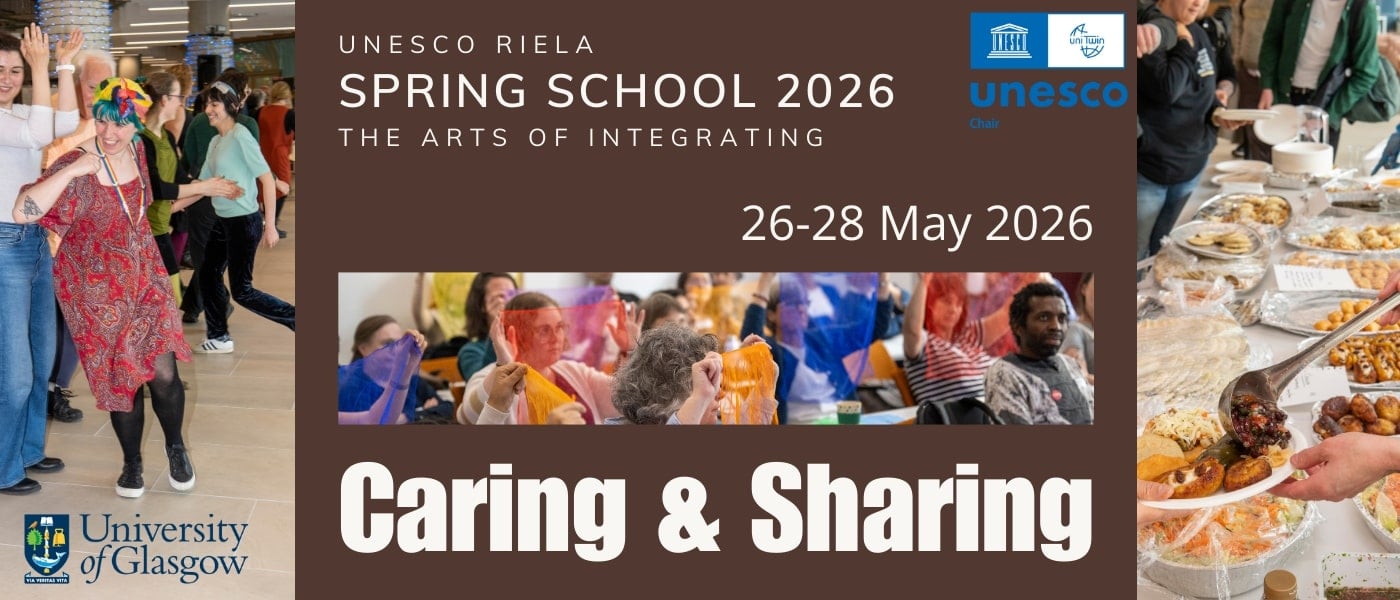
These and other questions will be looked at over the course of three days on 26-28 May in Glasgow, Scotland. UNESCO RIELA are now inviting community groups, artists, academics, students, third sector organisations, policy makers, migrants of all varieties and anyone working on community building and integration to respond to this call for contributions to their next UNESCO RIELA Spring School 2026. The Spring School is their annual knowledge exchange event that brings together academic and non-academic groups, to learn from and with each other.
Deadline for sending in proposals: 2 February.
The UNESCO Chair on Refugee Integration through Education, Languages, and Arts (UNESCO RIELA), hosted within the School of Education at the University of Glasgow, undertakes a programme of work focused on multilingual knowledge exchange in the area of refugee and humanitarian protection, with a focus on fostering multilingual, multimodal and multilateral models of integration through creative and cultural expressions. Chair activities take place in collaboration with researchers and research networks at Glasgow (e.g. GRAMNet) and internationally. We also work with artists, public and third sector organisations, NGOs, migrants and refugees. The Chair builds on research findings and partner priorities in such a way as to promote creative, practical multilingual action for change at all levels of society, in all contexts. Our research projects links us with Global South partners with experience of historical and present day refugee integration in their communities. The Chair works to support research and action focused on fostering cultural expressions of heritage and diversity with displaced peoples, and academic freedom for those at risk.
Please feel free to share this call in your networks. The event is open to all!
For any questions, you can contact Bella Hoogeveen on [email protected].