Originally published by Dyfi UNESCO Biosphere, this blog is shared here as part of the UK National Commission for UNESCO’s Local to Global programme, funded by The National Lottery Heritage Fund. It reflects on a recent workshop supported through the Local to Global community grants programme, exploring connections between nature and peace within a UNESCO context.
March 30th 2026, by Dyfi Biosphere
Academics and activists came together for a workshop to explore the relationship between nature and peace. How does this fit with UNESCO's mission on Wales? Darllen yn Gymraeg.
Our Biosphere is centred on the river Dyfi, which links the hills with the sea and opens into an estuary of exceptional beauty and ecological importance. It has always been a significant feature, but should we go further and recognise it as a living entity with legal rights, following the example of the Whanganui in New Zealand (watch the video) and the Ouse in Sussex?
The climate and biodiversity crises both challenge us to reassess our relationship with nature, and we wondered how this relates to the work of a Biosphere. When UNESCO was set up in 1945, its aim was to unite countries in peace so that the horrors of the world war would not be repeated. Education, science and culture were seen as a source of wisdom that would guide us towards better decisions. But what does nature have to do with the peace-building process?
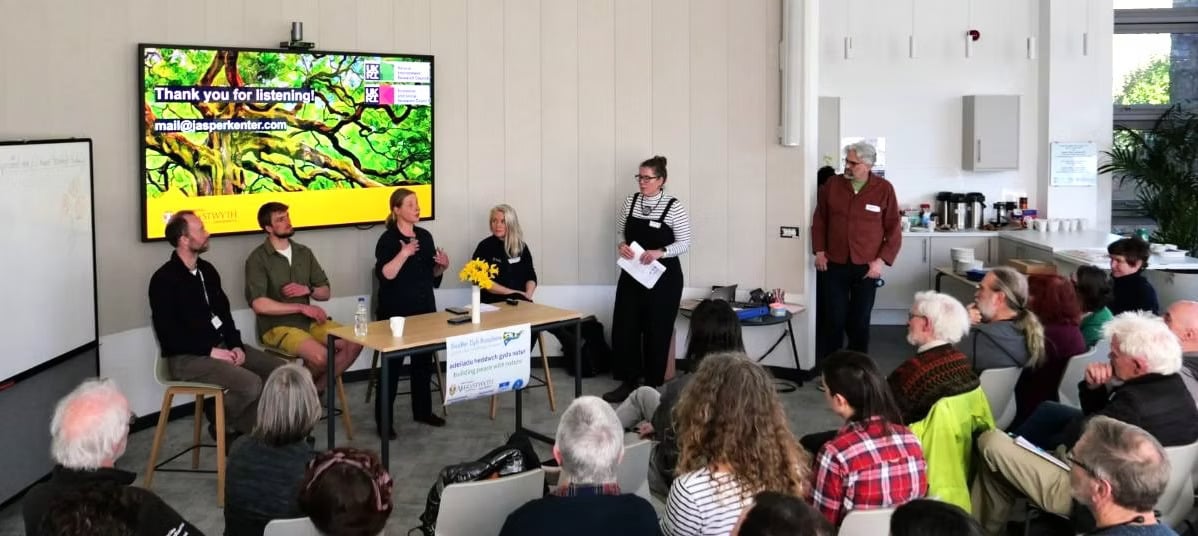
That was the background to our workshop in March organised jointly with the Department of International Politics at Aberystwyth University. It featured speakers from the university and Biosphere projects, as well as Prof Colin MacInnes from Academi Heddwch and Dr Elinor Gwynn from Dinas Llên Aberystwyth/Ceredigion.
Prof Milja Kurki, whose research has to do with humans as one among many species on the earth, explained how we have framed politics in terms of human language and thus excluded nature from our decision making, even though its voice can be heard in many other ways.
The scream of the swift is one example, and Ben Porter from Tir Canol and the Biosphere Swift Project told a story of their coexistence with humans. They have come to depend on us for nesting sites in our houses and churches, and then lost them again as we modernize our building methods. There was a lot of interest in swift nest boxes afterwards.
A better relationship with nature brings therapeutic benefits, as Rosie Strang from the Awyr Iach project explained (see their video), while Prof Jasper Kenter explored the significance of values that are grounded in our relationship with nature, and what it means to live ‘as nature’.
The afternoon’s focus was on how we care for nature. Linda Denton and Clare Wassermann of Coed Talybont regularly plant trees on farms, improving biodiversity and water retention in the landscape (see the video). They also construct willow dams and create human connection, and Clare’s reading of her blog about weaving, bringing in the old woollen mills at Talybont, brought a thoughtful note to the discussion.
Dr Hywel Griffiths spoke about the TRACC project, which is building resilience in coastal communities through a series of workshops. A major concern raised by TRACC participants is the sense of disconnection from government, something that Joe Wilkins also covered. How can we have two-way communication between the people who make policy and those who are its target, when silo thinking, vested interests and conflicting timescales get in the way?
Finally, Hannah Hughes shared her research on the relationship between farmers, scientists and policy makers in the Welsh Government and the difficulty of reconciling their very different viewpoints. Hannah also studies such relationships at the international level, for instance with the United Nations Framework Convention on Climate Change, and so parallels the Biosphere’s relationship with UNESCO.
Each talk added another angle to the relationship between humans and nature, and led to lively discussions during and between the sessions. Volunteers from several Biosphere projects – swifts, river testing and outdoor health – were on hand to share their work, and we collected responses on noticeboards at the end of the day.
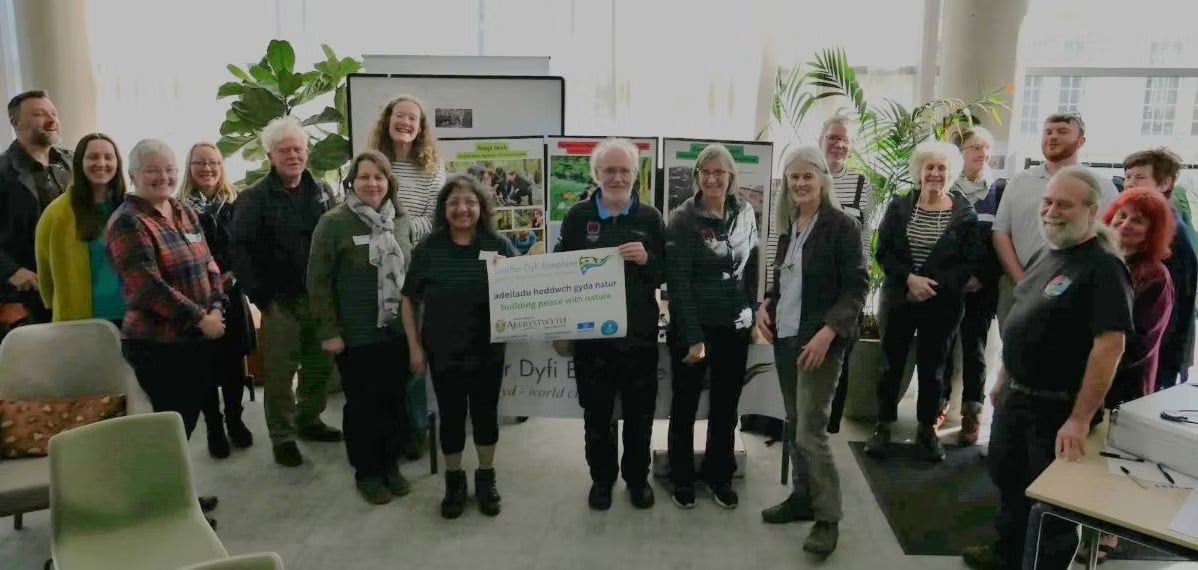
One person had been surprised to learn that “there are lots of people in academia and other grown-up jobs that have faith in the wisdom and concerns of us ordinary folk,” and another wrote “I feel slightly less hopeless about the world – maybe this thing of starting local – being careful about the small things – will overcome”.
People also made commitments to action: to spend more time outdoors, to learn from ecosystems, and to do creative projects. One suggested holding work meetings outdoors sometimes. Several were going to put up swift nest boxes.
The event was the first in a series of workshops around the Wales UNESCO network, to be followed by events in Fforest Fawr Geopark in April and GeoMôn Geopark in May, with an online event in June. They are supported by the UK National Commission for UNESCO's Local to Global programme with funding from the National Lottery Heritage Fund.
If nature has rights, it needs people to be a voice for it, and to care for it. That is what the Biosphere wants to support, and the direction shown by this workshop will shape our work for years to come.
Read more and download the publications here