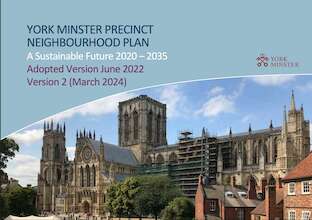

York - both a tentative World Heritage Site and a UNESCO Creative City of Media Arts - was the first place in England to adopt a neighbourhood plan for a heritage estate. Created under the Localism Act 2011, the York Minster Precinct Neighbourhood Plan (2022) provides a statutory, planning‑led framework for securing a sustainable future for the Minster and its seven‑hectare estate.
The plan exemplifies participatory governance through the Minster Precinct Neighbourhood Forum and close collaboration between the Chapter of York, City of York Council, Historic England, and local residents. As a community‑led plan, it guides development and conservation across the Precinct and forms part of York’s statutory development plan, giving it significant weight in planning decisions.
Alex McCallion FRICS, Director of Works & Precinct for York Minster, led the plan’s development and road to adoption by City of York Council. Alex reports that the plan’s implementation is now driving major change, particularly in retrofitting the estate to meet York’s decarbonisation priorities, including extensive renewable technologies. These works represent the most significant transformation of the Precinct since the 1850s.
A central policy is the creation of the Centre of Excellence for Heritage Craft Skills and Estate Management, establishing the Precinct as a world‑class campus for research, education, and training in traditional craft skills. The centre also expands capacity for stonemasons to undertake commissions for other ecclesiastical institutions and heritage estates using state‑of‑the‑art cutting technology. By supporting apprentices and providing dedicated residential facilities, it helps secure traditional craft skills for future generations.
The plan also sets objectives for heritage protection, landscape and public‑realm enhancement, community wellbeing, environmental sustainability, and economic resilience. It promotes conservation‑led development, prioritises reuse of historic buildings, protects key views and roofscape, and embeds long‑term maintenance planning to safeguard the Precinct’s integrity and authenticity.
With more than 700,000 annual visitors, the plan addresses sustainable tourism through improved visitor facilities and other initiatives, such as measures to reduce conflicts between pedestrians and cyclists. It also recognises climate change as a major long‑term threat, outlining policies for biodiversity protection, sustainable drainage, flood‑risk mitigation, and conservation of stonework and stained glass.
The York Minster Precinct Neighbourhood Plan aligns closely with UNESCO standards by prioritising heritage protection, sustainable development, community participation, and long‑term stewardship - core principles embedded in UNESCO’s World Heritage and cultural conventions. It provides a valuable model for existing UNESCO World Heritage Sites and supports York’s progression through the tentative list process. The plan is now available on the Resource Centre on the UKNC website.