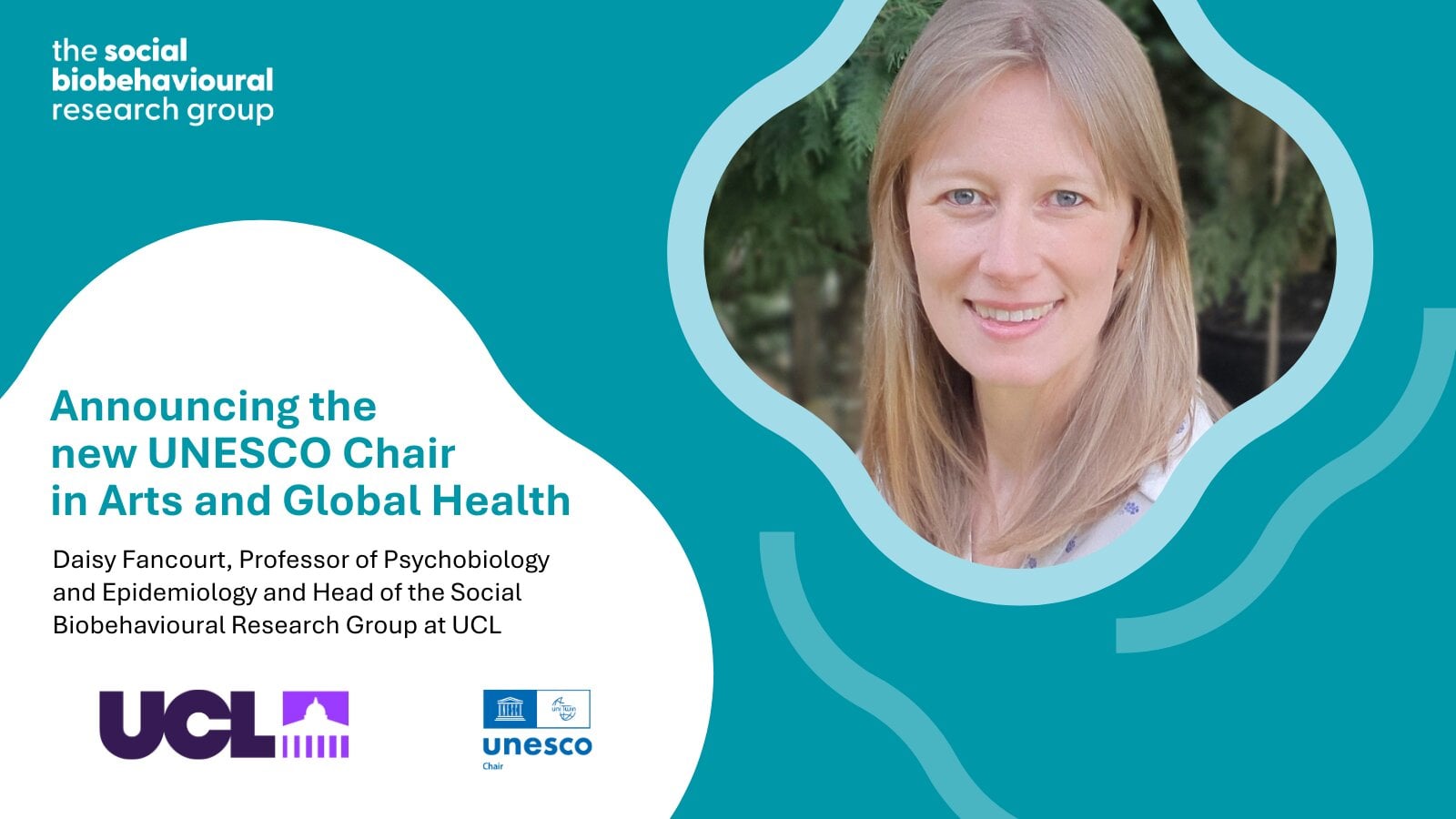
A UNESCO Chair is a team led by a higher education or research institution that partners with UNESCO on a project to advance knowledge and practice in an area of common priority. Professor Fancourt is a global expert on the health impact of arts engagement, recently publishing the Sunday Times bestselling book Art Cure: The Science of How the Arts Transform Our Health with Penguin Random House, which is currently long-listed for the international Women’s Prize for non-fiction.
Already the Director of a World Health Organization (WHO) Collaborating Centre on Arts and Health based at UCL, this prestigious designation makes Professor Fancourt only the second holder globally of both the UNESCO Chair and WHO Collaborating Centre Director status, bringing together an international programme of work to influence policy and practice in the field of arts and health.
The Chair’s activities will focus on quantifying the long-term health and wellbeing benefits of arts and cultural engagement in communities as well as in formal education and informal learning across the life-course, to strengthen the case for their prioritisation. This includes understanding global patterns of arts engagement and barriers to access through analyses of multi-country surveys, to provide a clear picture of where access to the arts is inadequate, unequal, or unjust. In addition, Professor Fancourt will be working closely with UNESCO as well as with the WHO on trials of ‘arts on prescription’ and broader ‘social prescribing’ initiatives in multiple Global South and North countries to assess whether such schemes can increase equity of arts and cultural engagement and improve health outcomes. Major new policy reports, technical briefings and resolutions will also be produced jointly with UNESCO and the WHO in order to build global collaboration and research capacity on arts and health.
Professor Daisy Fancourt, UNESCO Chair and Professor of Psychobiology and Epidemiology at UCL, said:
“I’m delighted to be named as a UNESCO Chair. Through our work with WHO over the past nine years we’ve achieved major policy progress integrating a consideration of arts into health policies in many countries internationally. The new UNESCO designation gives us an exciting remit to consider opportunities within cultural policies and international practice too.”
Cecilia Barbieri, Chief of Section on Global Citizenship and Peace Education, UNESCO Education Sector, and co-Lead of the Implementation of UNESCO Framework for Culture and Arts Education, said:
“The establishment of this UNESCO Chair at University College London marks a significant milestone for advancing the integration of culture and education as a catalyst for health and well-being. This Chair operationalizes the UNESCO Framework for Culture and Arts Education, bringing together a global programme of work to influence policy and practice. Building on this promising collaboration between UNESCO and UCL, it will strengthen evidence-based integration of culture and arts across health and education policies worldwide.”
Professor Anne Anderson, Chair of UK National Commission for UNESCO, said:
“The UK National Commission for UNESCO is delighted to congratulate Professor Daisy Fancourt on becoming a UNESCO Chair. The important work she does on demonstrating the health and wellbeing benefits of engaging with Art, Culture and Heritage will be an enormous benefit to our UK UNESCO Chairs network.”
The programme of work will be delivered by Professor Fancourt and a team of colleagues within UCL including Professor Andrew Steptoe, Dr Hei Wan Mak, Dr Feifei Bu, Dr Daniel Hayes, Rachel Marshall, Nikita Arslanovski and Maria Kristensen. It will also see UCL working in close collaboration with international partners including the WHO, Jameel Arts and Health Lab, Global Cultural Districts Network, Art and Global Health Center Africa, Global Arts in Medicine Fellowship and academics across the UK, Japan, Chile and Malawi. The UNESCO Chair role builds on the recent announcement of GRACE-Epi, a major new 7-year programme of work on arts and health funded through a £3.5m Wellcome Discovery Award. Led by Professor Fancourt, this programme is bringing together a consortium of global researchers to unite expertise from arts, humanities, social science, epidemiology, data science and molecular biology and radically advance epidemiological research on arts and cultural engagement.