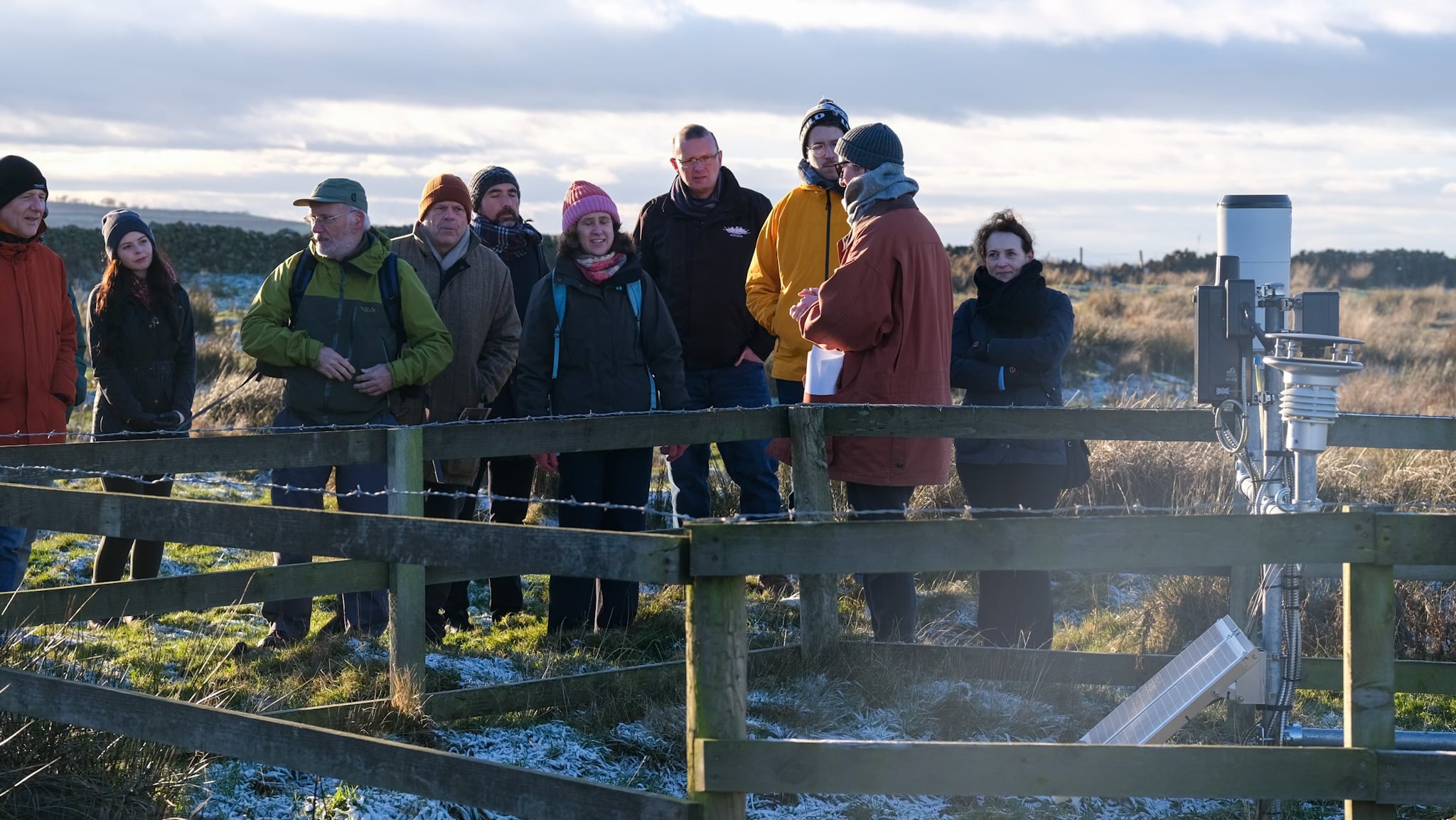
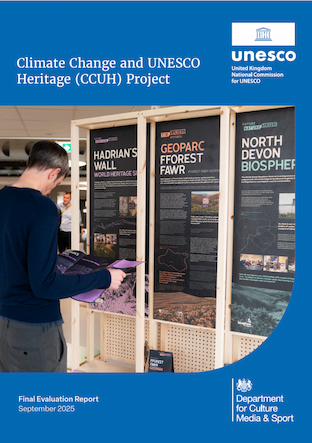
Working across three UNESCO sites, Hadrian’s Wall UNESCO World Heritage Site, North Devon UNESCO Biosphere, and Fforest Fawr UNESCO Global Geopark, the CCUH programme tested new, place-based approaches to climate adaptation, governance, data use and joint working.
The evaluation confirms a clear outcome: UNESCO sites provide uniquely powerful real-world testbeds - “living laboratories” - for addressing interconnected climate, cultural and natural heritage challenges.
A national programme with local impact
Climate change is already creating complex, interlinked risks across the UK’s cultural and natural heritage, yet the very data needed to understand these threats remains fragmented, inconsistent or inaccessible. National reviews have repeatedly highlighted major gaps in local-level climate, heritage and environmental datasets, alongside barriers to cross-sector collaboration and data sharing. At the same time, no single public body holds the full picture: climate adaptation, planning, nature recovery, cultural heritage and local governance each sit in different parts of government, limiting coordinated action.
The CCUH project was designed to address this gap by creating the data foundations, shared tools and joint working models needed for genuinely place-based climate action. It tested whether UNESCO sites, with their long-standing partnerships, could act as the real-world environments needed to trial new data catalogues, FAIR data tooling and participatory governance approaches at landscape/place-based scale.
Over 18 months, the CCUH programme:
- Directly funded and supported three UNESCO sites, enabling them to test participatory climate adaptation models, new governance approaches, and shared action planning.
- Delivered new open-source data catalogues, threats and opportunities dashboards, and FAIR data tooling to strengthen local decision-making and improve access to climate, heritage and environmental information.
- Piloted new creative and community engagement methods, capturing over 600 stakeholder insights and community perspectives through the FutureScapes engagement model.
- Convened twelve UK Government departments and agencies in a new cross-government governance structure, demonstrating how heritage can act as a common platform across policy silos such as climate, planning, nature, data and community development.
Andrew Bell, Director of North Devon UNESCO Biosphere Reserve, said:
“This has been a really helpful project that has enabled us to stimulate cross-sectoral working on climate change, natural heritage and human health. The key tools for working with stakeholders has enabled us to work with local decision makers on how we can future proof development plans for biodiversity, health and nature creating a win/win/win solution. Our work will hopefully continue having been given this important impetus to improve sharing data with stakeholders and to have maximum impact. Further, we enjoyed the collaboration with Fforest Fawr and Hadrian’s Wall to broaden our perspective and to look at solutions and problems differently.”
Toby Pitts, Fforest Fawr UNESCO Global Geopark, said:
“We found the UNESCO Climate Change and Heritage Project a hugely rewarding undertaking that catalysed internal ways of working and allowed us to test a range of exciting tools and methodologies across our site. Working with a range of experienced consultants enabled us to better understand how our stakeholders interact with their local designation and allowed us to create the foundation for future action plans and risk assessments. Through collaboration with the other pilot sites and wider UNESCO network we were able to compare and contrast our localised climate challenges in order to build up a valuable picture of common challenges and best practice in the areas of adaptation and resilience.”
Matt Rabagliati, Head of Policy, Research and Communications, UK National Commission for UNESCO (UKNC), said:
“UNESCO sites are on the frontline of climate change – places where culture, nature, and communities meet, and where collaboration becomes solutions. The project showed that the most significant breakthroughs come not from flashy innovation, but from getting the basics right: trusted partnerships, shared dialogue, and open data that empowers people to act together.
This work is already shaping significant international funding and new European programmes. By launching this evaluation, we hope we are reinforcing what matters most, protecting heritage, strengthening communities, and investing in the partnerships the climate-resilient future urgently needs.”
Key findings from the evaluation
The independent evaluation highlights that CCUH has:
- Demonstrated the importance of UNESCO sites as platforms for systemic, place-based climate action: Their ability to unite cultural heritage, natural heritage, data, governance, and community identity gives them a unique advantage in testing how sectors can work together.
- Strengthened stakeholder participation and local capacity: Participatory models co-designed with UCL Climate Action Unit gave partners a shared understanding of climate threats, and improved confidence in joint planning and decision-making. Two of the three pilot sites are already planning to embed these models long-term.
- Developed new digital infrastructure and data tools: The programme delivered the UK’s first cross-UNESCO FAIR data catalogue prototypes, a multi-sector threats and opportunities dashboard, and open-source coding libraries, all designed to be scalable, reusable and adaptable across the UK and internationally.
- Revealed that data alone is not enough, people and collaboration are the real drivers of change: The evaluation stresses that while data and tools are essential, trusted relationships, shared understanding, and dialogue are the foundation of successful adaptation.
- Shown strong alignment with the UK Government’s emerging devolution and ‘place’ agendas: By strengthening local governance, integrating local knowledge and improving access to actionable data, CCUH demonstrates a practical model for place-based climate work across multiple sectors.
FutureScapes and open-source climate tools launching later this year
One of the strongest legacies of the programme is the development of FutureScapes, a visual identity, open toolkit and touring exhibition designed to bring climate, culture and community perspectives into local planning and policymaking.
The full suite of FutureScapes tools, along with the open-source data catalogue, dashboard and digital resources, will be launched publicly later in the year, enabling any community, local authority, UNESCO site or partner organisation to use, adapt and build upon the CCUH models.
A lasting legacy
The evaluation concludes that CCUH has:
- Strengthened the role of cultural and natural heritage in climate adaptation.
- Demonstrated the value of UNESCO sites as national and international “living laboratories”.
- Laid the foundations for new cross-sector, place-based climate approaches.
- Positioned the UK 18 months ahead of comparable international work, and directly shaped the design of a new €200 million European programme on climate and heritage.