Key Information
Register:
NationalYear of Inscription:
2024Type of Heritage:
DocumentNominating Institution:
University of AberdeenLink to Website:
www.abdn.ac.uk/about/campus/old-aberdeen/kings-college
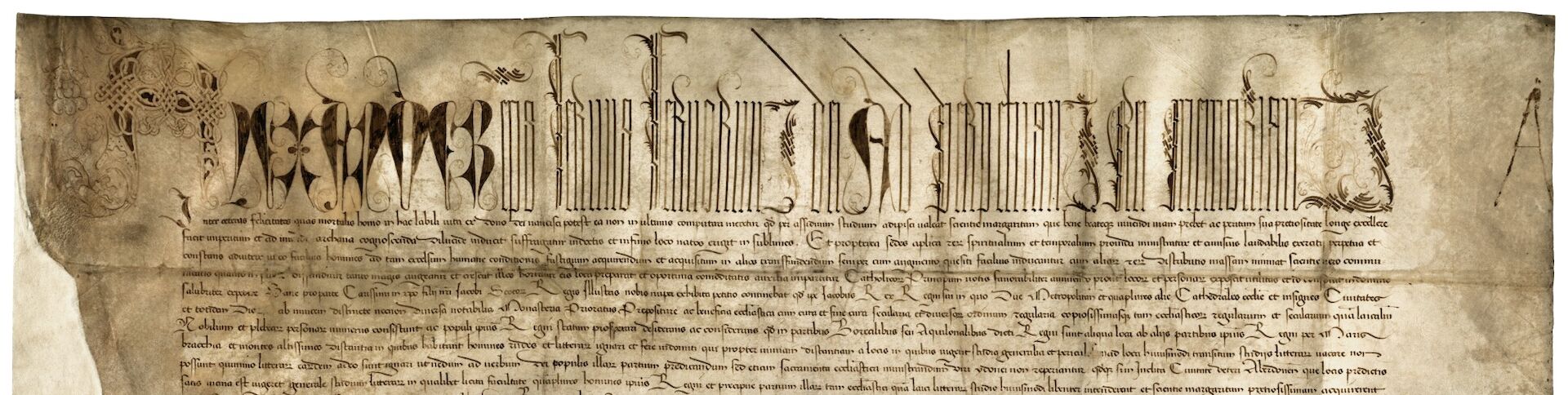
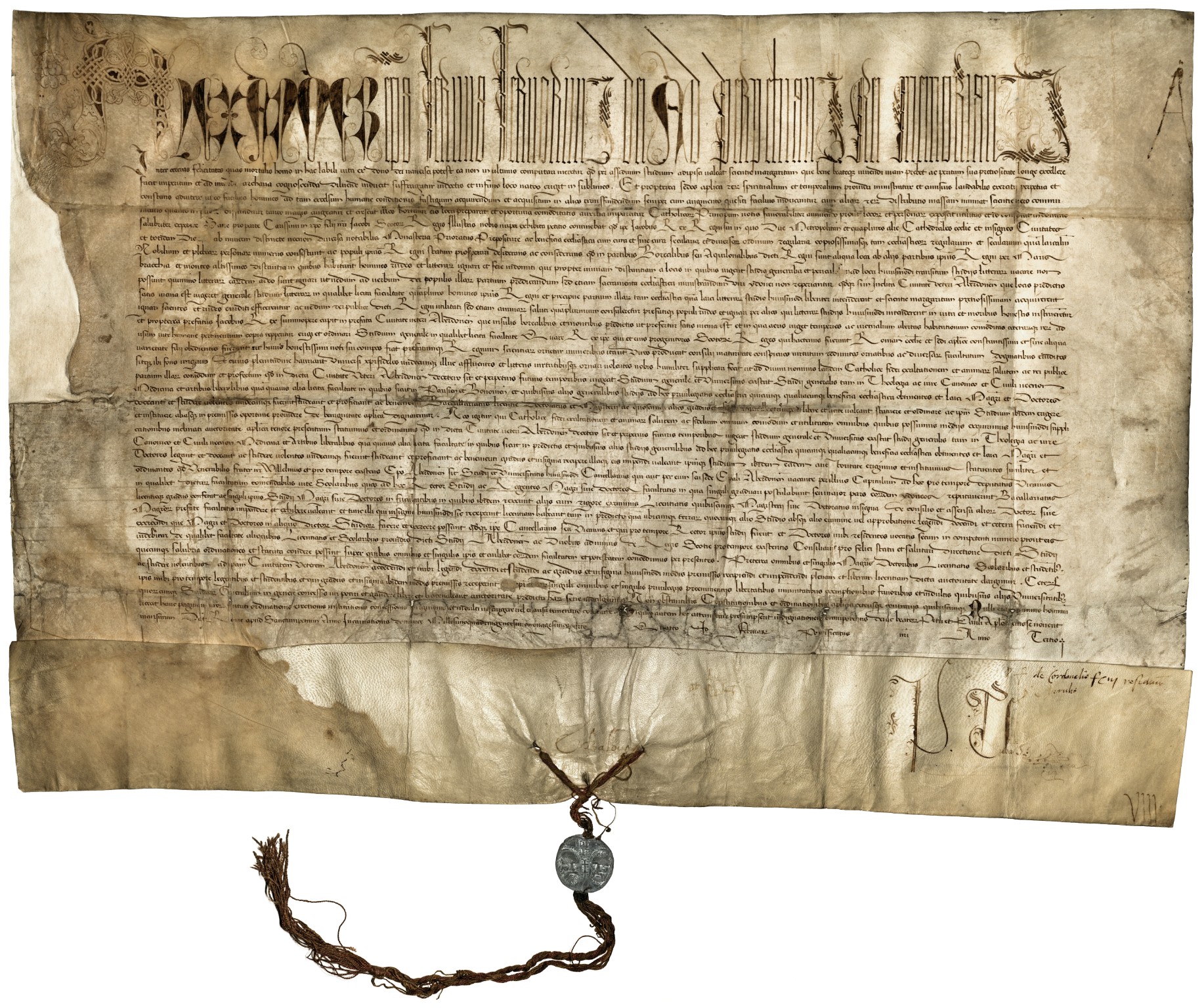
The Foundation Papal Bull of the University of King’s College, Aberdeen, dated 10 February 1495, granted permission for James IV of Scotland to establish a university in Old Aberdeen. Issued by Pope Alexander VI, the document set in motion the creation of King’s College, one of Scotland’s oldest universities.
The Foundation Bull was issued to King James IV but the majority of the content was composed by William Elphinstone, the Bishop of Aberdeen, who had travelled personally to Rome to seek papal permission. This document set in motion an enterprise to create a centre of higher learning, King’s College, which would take Elphinstone the next ten years to complete.
The Foundation Bull is of great cultural and historical significance to the modern day university and city of Aberdeen but it also reflects many aspects of the political, cultural and educational state of Scotland at the end of the 15th century. In Scotland, higher education, particularly law and medicine, was embedded in all the major settlements thanks to its ancient universities. This was to have an impact not only in Scotland but in the United Kingdom and the world.
Establishing a university in Aberdeen was also part of James IV’s aim to unify his realm. His focus on the outlying areas of the country included an extensive reform of legal training to provide efficient lawyers and a unified Scottish legal system. His educational reforms included an Education Act in 1496 stating that all landowners were to send their sons to schools to become competent in Latin, and to study Law and Arts. As a leading cleric and Keeper of the Privy Seal, Elphinstone was central to these aims as he also attempted to reform the late medieval church by providing an educated, modern clergy.
In founding a university in Aberdeen, Elphinstone established and supported a humanist curriculum with an emphasis on educating a professional laity, fostering a medical faculty and creating a thriving liberal arts course based on a current, European model. All of which would be a vital component of the flourishing Scottish Renaissance.