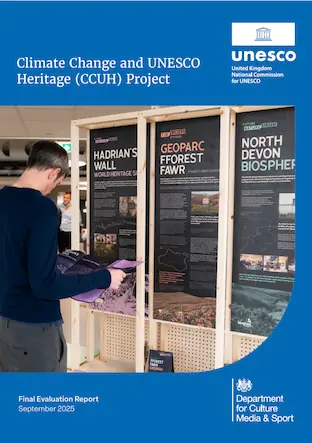
Working across Hadrian’s Wall World Heritage Site, North Devon Biosphere Reserve, and Fforest Fawr Geopark, the project tested new place-based models for climate adaptation, governance, data use and community engagement.
The evaluation confirms that UNESCO sites offer uniquely powerful real-world environments – “living laboratories” – where climate, culture, nature and communities converge, enabling cross-sector partners to trial new approaches to resilience and decision-making.
Key outcomes include:
Stronger local capacity and participation: Sites tested participatory climate-adaptation methods, building shared understanding of risks and improving confidence in joint planning.
New digital infrastructure: The programme delivered the UK’s first cross-UNESCO FAIR data catalogue prototypes, a threats and opportunities dashboard, and open-source tools to improve access to climate, heritage and environmental data.
Improved cross-government working: Twelve departments and agencies engaged in a new governance structure, demonstrating how heritage can act as a common platform across climate, planning, nature and data agendas.
Innovative community engagement: The FutureScapes model captured insights from over 600 stakeholders, using creative approaches to support place-based climate dialogue.
The evaluation concludes that people and partnerships, not technology alone, drive effective climate action, and that UNESCO sites provide the collaborative conditions needed for systems-based, landscape-scale responses.
The project has strengthened the UK’s leadership internationally, informing a new €200m European programme on climate and heritage and positioning the UK 18 months ahead of comparable global work.
All open-source tools, data resources and the FutureScapes toolkit will be launched publicly later this year.